Why Startups Fail: The Success Equation Most Founders Ignore.

Why do so many startups fail even when the product looks good on paper?
Most startup failure stories are too neat.
A founder says the product was too early. An investor says distribution was weak. The team says the runway was too short. Usually each explanation contains something true and still misses the deeper point.
Working on Pasella has made that harder for me to ignore. Startup success is multiplicative. You can have a real problem, a useful product, and genuine demand, then still lose because trust is weak, adoption is heavy, distribution is thin, or timing is off. Founders talk about product-market fit like it explains everything. It does not. Product-market fit matters, but so do trust, adoption, retention, distribution, and timing.
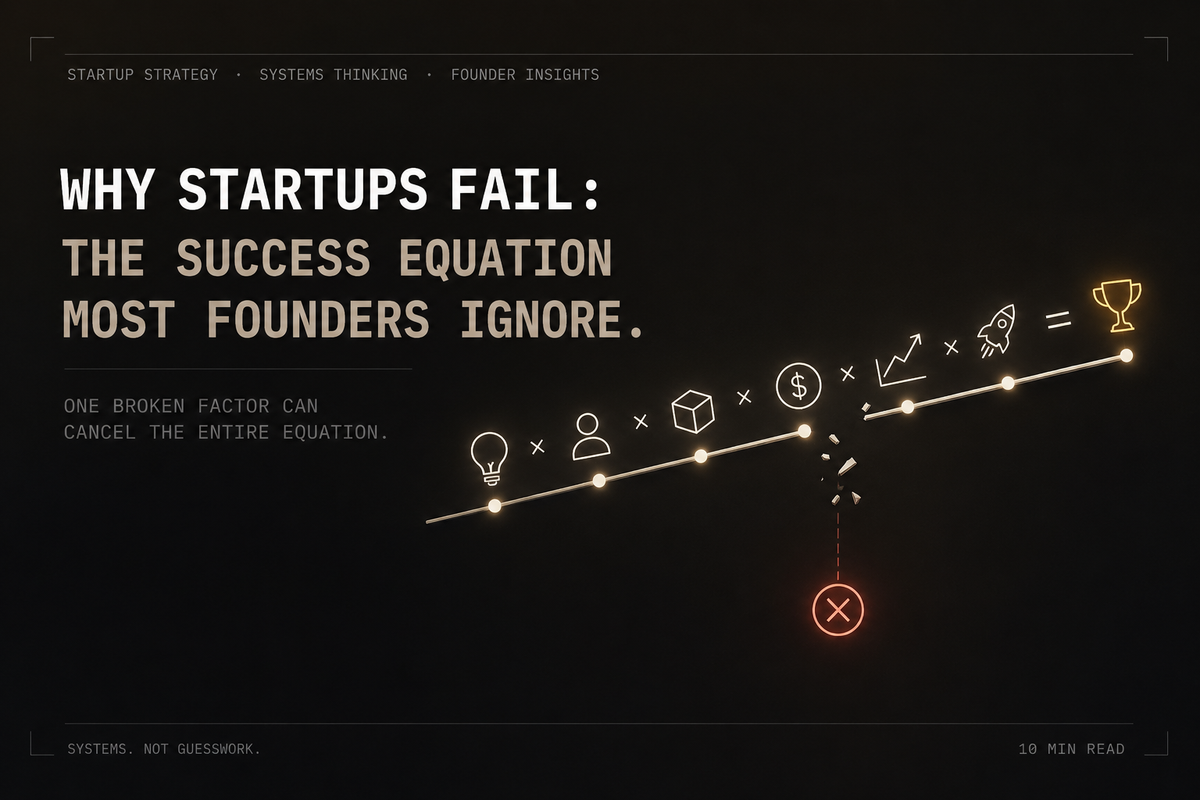
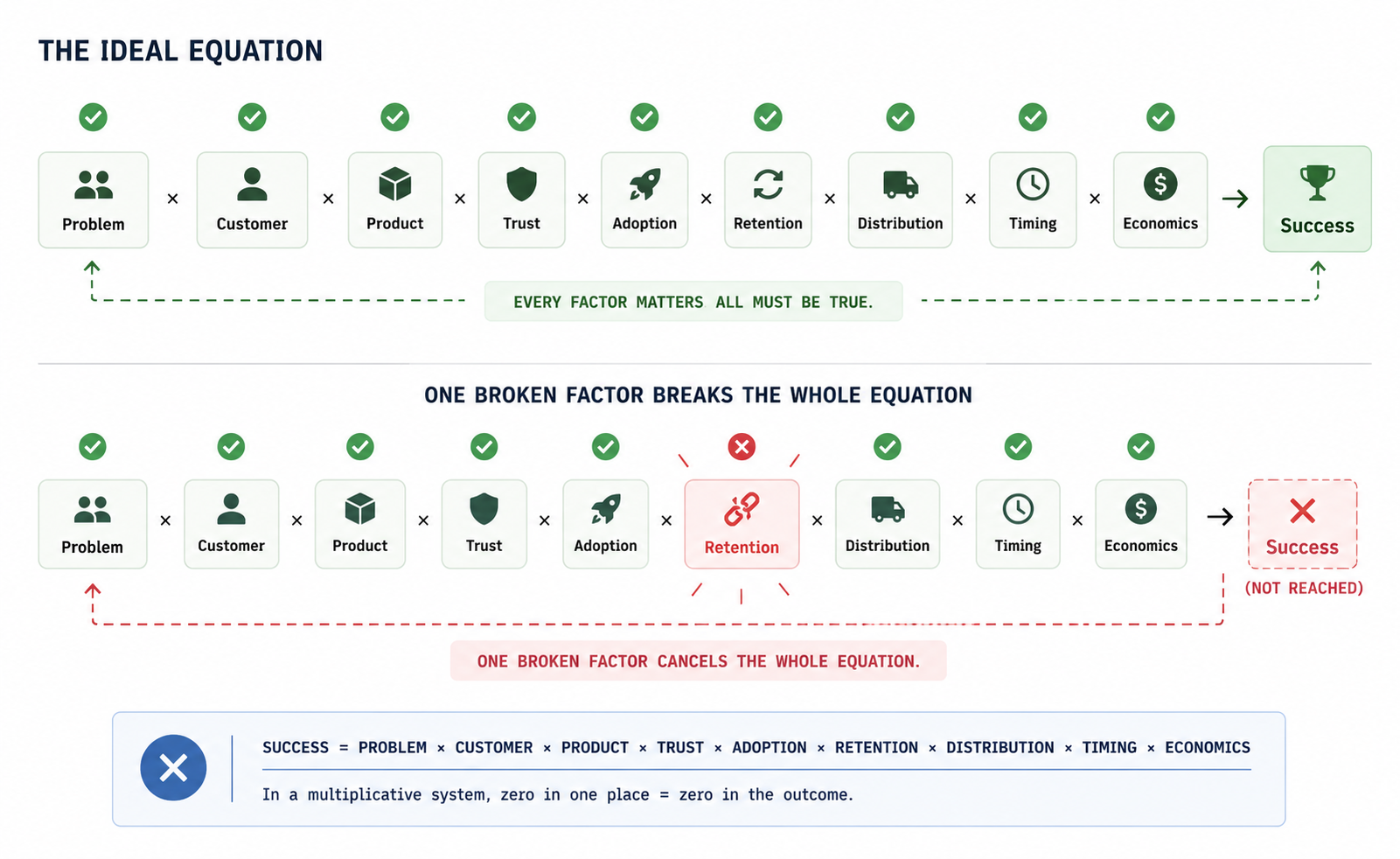
Most startups do not fail because everything was wrong. They fail because one broken factor sat in the middle of the business long enough to cancel the rest.
Success is multiplicative, failure is not. A simple way to see this is with a restaurant.

A competent kitchen staff matters. The right location matters. A menu people actually want matters. Pricing matters. Service matters. Hygiene matters. Timing matters. If enough of those things are right, the restaurant has a real chance.
Now change just one variable.
Put it in the wrong neighbourhood. Or make the food take too long. Or price it badly. Or hire weak front-of-house staff. Suddenly the quality of the chef does not save you. The menu does not save you. The decor does not save you. One broken factor starts wiping out the strength of the others.
That is what I mean when I say success is multiplicative. It is not a neat sum where a few strong areas cancel out the weak ones. It is closer to this:
right problem × right customer × product that works × trust × adoption × retention × distribution × timing × workable economics = success
If one of those factors is badly wrong, the whole equation starts weakening.
That is also why failure is so easy to misread. Most businesses do not fail because everything was wrong. They fail because one thing was wrong enough to stop everything else from compounding.
Why founders misdiagnose failure
This is where founders get themselves into trouble.
When growth stalls, most of us reach for the explanation that feels closest to our skill set. Technical founders blame the product. Marketers blame distribution. Sales-led founders blame the pitch. Finance people blame burn. Everyone tends to find the problem they are most comfortable solving.
I understand the instinct because I have done it too.
With Pasella, it has been easy at different points to think the answer was just one more product improvement. Clean up onboarding. Tighten the ledger flow. Make reminders clearer. Improve the WhatsApp experience. Those things all mattered. Some of them mattered a lot. But the deeper lesson was that product quality alone does not close the equation.
You can have a useful product and still lose if trust is weak. You can improve trust and still lose if adoption is too thin. You can improve adoption and still lose if repeat usage does not settle into habit. You can get usage and still lose if distribution is inconsistent or too expensive. You can even get several of those right and still lose if the timing is wrong and the market is not ready to move.
That is why so many startup postmortems feel incomplete. They name the last thing that broke, not the factor that had been quietly poisoning the system earlier.
A company says it ran out of cash. True, but that is often the final event, not the first cause. Somewhere before that, the product never fully locked into real demand. Or trust never got high enough. Or adoption never got easy enough. Or distribution remained too weak for the economics to hold. By the time the cash problem becomes visible, the actual damage has usually been compounding for months.
Product-market fit is not enough
Product-market fit is one of the most important ideas in startup building. It deserves the attention it gets. If nobody really wants what you built, nothing else matters for long.
But founders often stretch the concept until it tries to explain everything.
A startup can have signs of demand and still fail. A few customers can love the product and still fail to create a business. A problem can be real and urgent and still not turn into a durable company if the rest of the system does not hold.
That matters because product-market fit is often treated like the finish line. It is closer to a door.
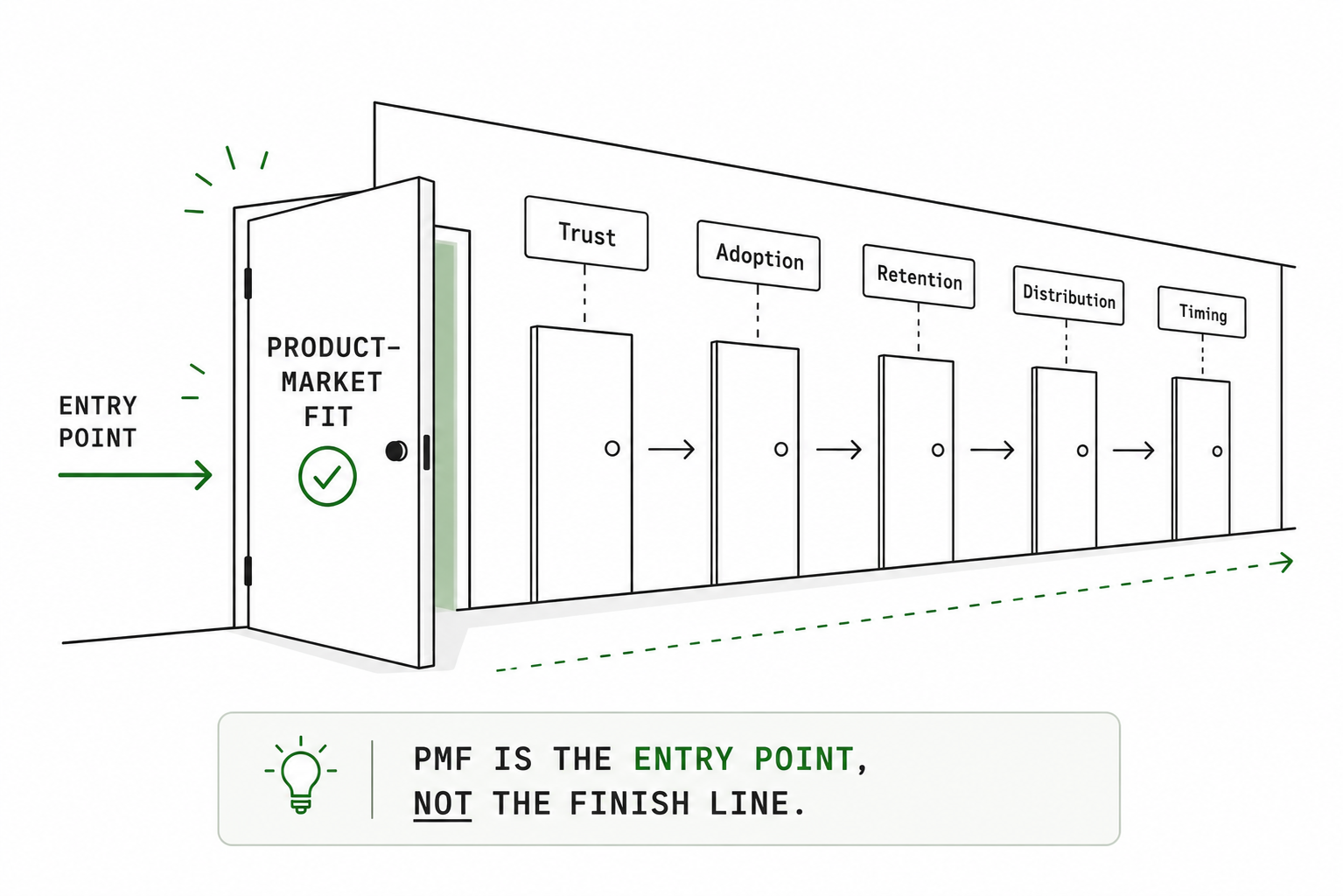
You still need customers to trust you enough to buy. You still need the product to be simple enough to adopt. You still need retention, because short-lived usage flatters the ego and kills the company. You still need distribution, because good products do not automatically become visible. You still need economics that hold under real conditions, not just in a deck. You still need timing that is good enough for the market you are in.
Founders like single-cause stories because they are easier to act on. If the problem is only product-market fit, then the answer is obvious. Go talk to users. Rework the offer. Improve the product.
Sometimes that is exactly right. But not always.
Sometimes the product is good enough, and the real issue is that nobody trusts a young company with an important workflow. Sometimes the trust is there, but adoption is too heavy because setup friction is still too high. Sometimes the adoption is decent, but the business cannot afford the cost of reaching users. Sometimes the economics work in theory, but not in the actual market you are serving. Sometimes everything is reasonable, but the timing is six quarters too early.
That is not the same problem. So it should not get the same diagnosis.
The startup version of the success equation
For most startups, the equation looks something like this:
- a real problem
- the right customer
- a product that works
- clear value
- trust
- adoption
- repeat usage
- distribution
- workable economics
- timing