Suffering Is a Market Signal. Here Is How to Read It.

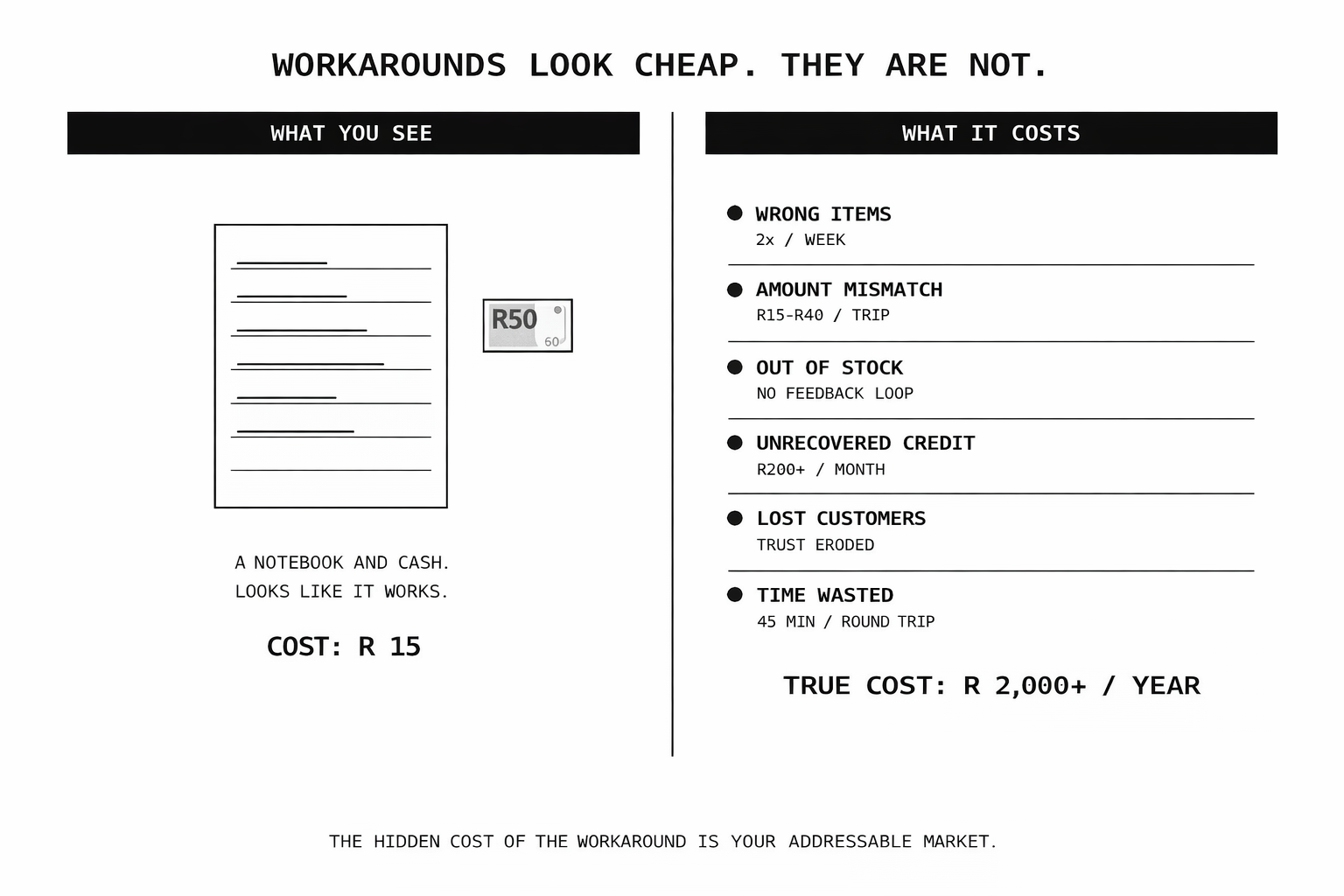
The notebook was a school exercise book, the kind you buy in a three-pack at PnP for about fifteen rand. Blue cover. Faint ruled lines. Corners curled from being opened and closed fifty times a day. It was the entire credit management system for a spaza shop in Sterkspruit, and I was one of the names written in it.
I bought from this shop regularly. Bread, milk, airtime, the usual. Like many regular customers, I sometimes bought on credit. He would write my name, the date, and the amount in the notebook. On the surface, it worked. In practice, it leaked.
Pages tore. Entries smudged. Balances were missed. A payment would happen and the record would lag behind it. Per customer, the losses looked small. Across thirty or forty regulars over a year, they became serious. The notebook cost fifteen rand. The system built around it was costing far more.
I did not see a software opportunity in that moment. I saw a man working harder than he should have needed to, absorbing costs he did not deserve, because nobody had built him something better than a pencil. That observation stayed with me longer than any market research report I have read since, and it eventually became the seed of what we started building at Pasella: a way to bring that paper ledger into a system that could actually keep track.
The more I paid attention, the more I realised this was not an isolated story. It was a pattern repeating across thousands of informal businesses, and it pointed to something the African tech ecosystem often talks about but rarely does well: reading suffering as a market signal.
The pattern behind every durable African tech company
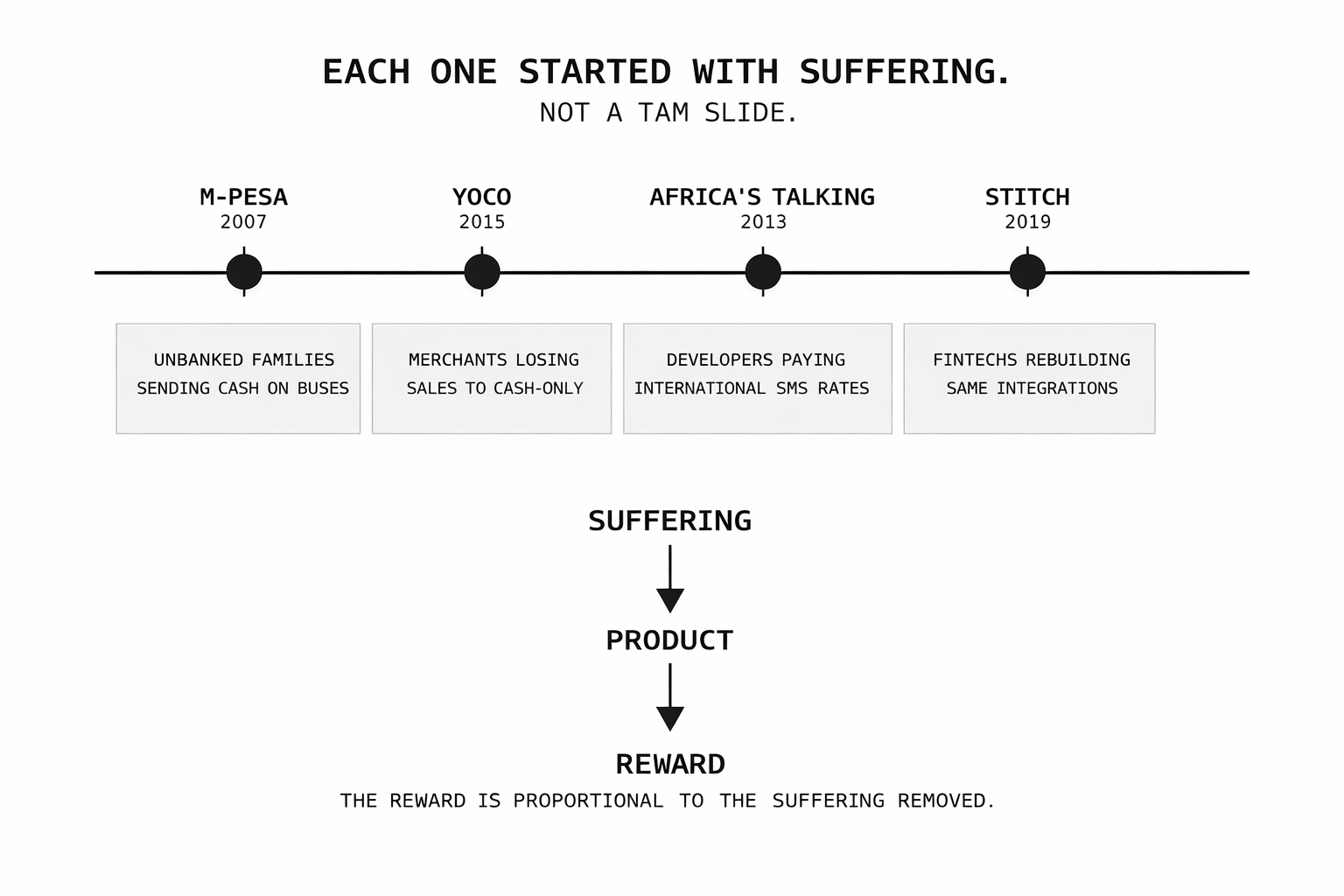
M-Pesa did not start with a fintech thesis. It started with the observation that Kenyans were sending airtime to each other as a proxy for money transfers because the banking system would not serve them. The suffering was visible to anyone who looked: families separated by distance, paying a tax on every transfer to middlemen and bus networks, losing money to theft and miscounting along the way. Safaricom built the product that made that suffering stop. The reward was proportional.
Yoco saw card-excluded merchants across South Africa, businesses turning away customers because they could only accept cash. Today it serves more than 200,000 merchants and processes over R34 billion per year, built entirely on removing a single friction: the inability to accept a card payment.
Africa's Talking saw developers paying international rates for local communications infrastructure, building workarounds on top of workarounds because nobody had built an API layer that worked natively across African telcos. Stitch, the Cape Town payments infrastructure company that has raised over $107 million in funding, saw the fragmented mess of payment integrations that every South African fintech had to rebuild from scratch.
Different sectors. Same starting point.
These companies did not begin with abstract market theory. They began with a form of pain that was already costing people time, money, or trust. The pain had become normal. That is what made it easy to miss, and valuable to notice.
Why suffering is a better signal than demand
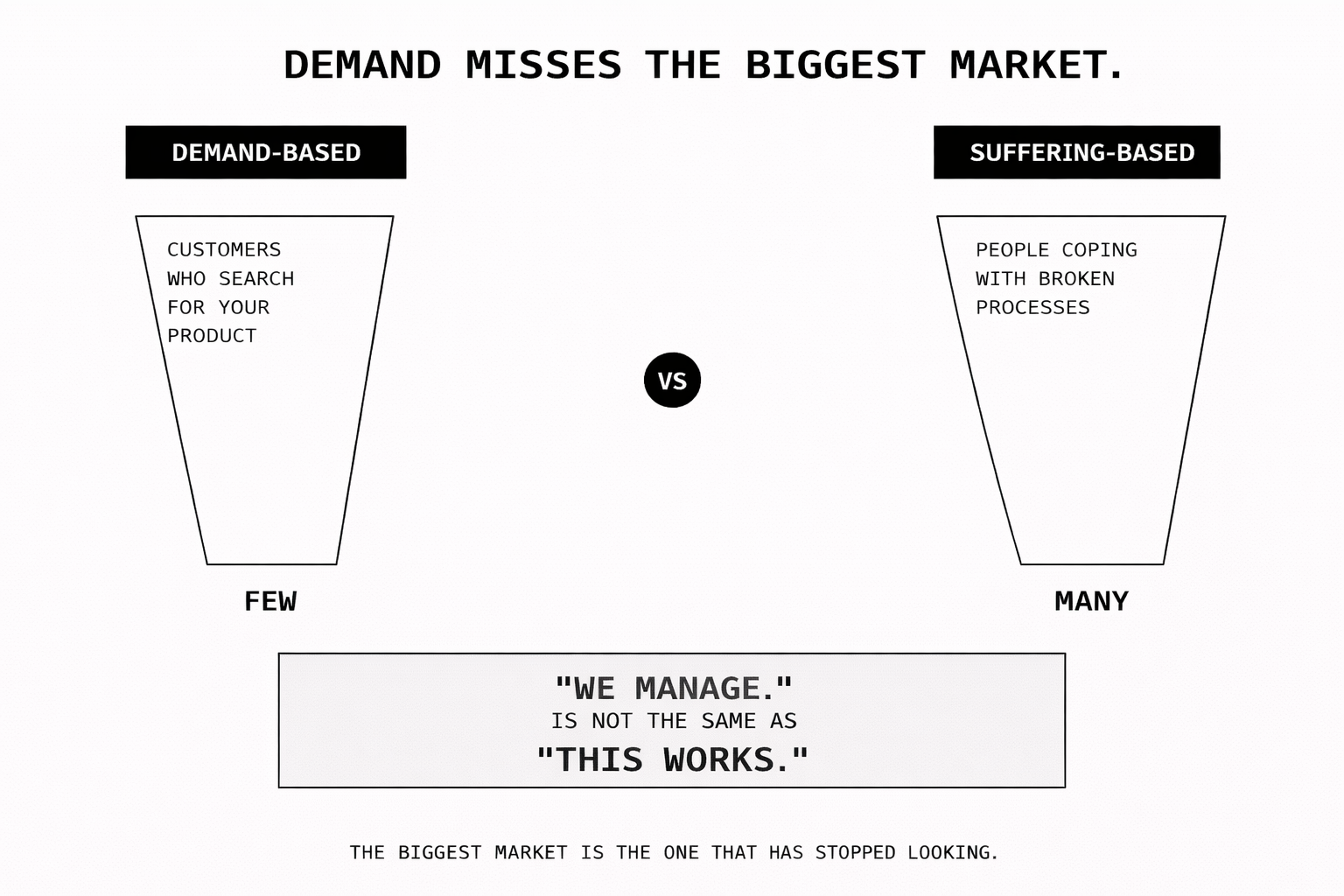
Traditional product thinking says you should find demand and serve it. That works when customers know what they want. In markets where digital solutions are still relatively new for large parts of the economy, customers often do not know what to ask for because they have never seen the alternative. The spaza shop owner was not looking for invoicing software. He did not search for "credit management app for informal retail." He was just trying to remember who owed him what, using the only system he had ever known.
Demand-based thinking would have missed him entirely. Suffering-based thinking would not, because the suffering was visible to anyone willing to sit in the shop for an afternoon and watch the process fail.
I experienced the other side of this too. I would need something from a nearby shop and send my son with a piece of paper listing what to buy and cash folded inside. Sometimes the amounts would not match. Sometimes items were out of stock and there was no way to communicate that without sending him home and back again. The workaround functioned the way all workarounds function, which is to say it worked just well enough that nobody felt the urgency to replace it. But the friction was constant. The accumulated cost in time, errors, and small frustrations that compounded over months was real and completely invisible from the outside.
If you want to uncover this kind of hidden pain in your own market, there is a simple method that works better than any survey: spend a full day shadowing a customer. Not interviewing them, just watching. Sit in the shop. Follow the delivery route. Watch the WhatsApp group. The suffering reveals itself in the workarounds people have stopped noticing, in the moments where they sigh and move on instead of complaining.
The founders who see these moments clearly have an advantage that no amount of market research can replicate. They can size a problem by watching it happen, not by reading about it in a report.
How to size the suffering
Not every frustration deserves a company built around it. Three questions help separate a real business from a mild annoyance.
Is the suffering recurring?
A once-off irritation is usually a feature request. A pain that shows up daily or weekly is much more likely to support a business. The spaza owner was not occasionally losing track of credit. The weakness was built into the process. That made it frequent, predictable, and expensive. A simple test: over two weeks, count how many times the same person hits the same problem. If it shows up constantly, pay attention.
What does the current workaround actually cost?
Most workarounds look cheap because the direct software cost is zero. The real cost sits elsewhere: unrecovered debt, wasted time, missed orders, poor visibility, preventable errors, strained trust. That notebook cost fifteen rand. The losses around it did not. A logistics business coordinating drivers through WhatsApp may spend almost nothing on software and still lose hours every day to manual reconciliation and missed updates. Once you estimate the hidden cost of the workaround, you get much closer to the value of fixing it.
Who is suffering silently?
The strongest opportunities often sit with people who have stopped complaining. Enterprise customers will often hand you requirements. SMEs will tell you, "It is fine, we manage." That phrase matters. "We manage" often means the process is weak, but familiar. It means the pain has been normalized. If you want to find it, ask a simple question: What did you try to do this week that was harder than it should have been? Then listen for the parts they describe as ordinary. That is often where the real product opportunity sits.