Your Competitor Can Copy Your Features. They Cannot Copy How Well You Know Your Customer.

The founder is sitting across from a woman who runs a small logistics business out of Witbank (eMalahleni). She has been using the product for four months. The founder drove all the way from Johannesburg to see her, which she found slightly strange, but she agreed to the meeting.
For the first twenty minutes, she says everything is fine. The product is good. She has no complaints. The founder asks the same question three different ways and gets three variations of the same polite answer.
Then, almost as an afterthought, she mentions the workaround.
Every Monday morning, before she opens the app, she exports her data into a spreadsheet and recalculates everything manually. It takes about forty-five minutes. She has been doing it since the second week. She assumed it was just how the product worked.
The founder drives back home to Johannesburg, pulls the engineering team into a room, and cancels the next two sprints. They are not behind on delivery. They have been building the wrong thing. Nobody would have known if the founder had not been in that room.
This is what empathy looks like in practice. Not a framework. Not a customer persona document. A founder sitting with a real person, asking the same question enough times that the polished answer runs out and the true one comes through.
Most founders never get that conversation. Not because their customers are hiding things, but because they stopped showing up to have it.
The Distance That Kills Companies
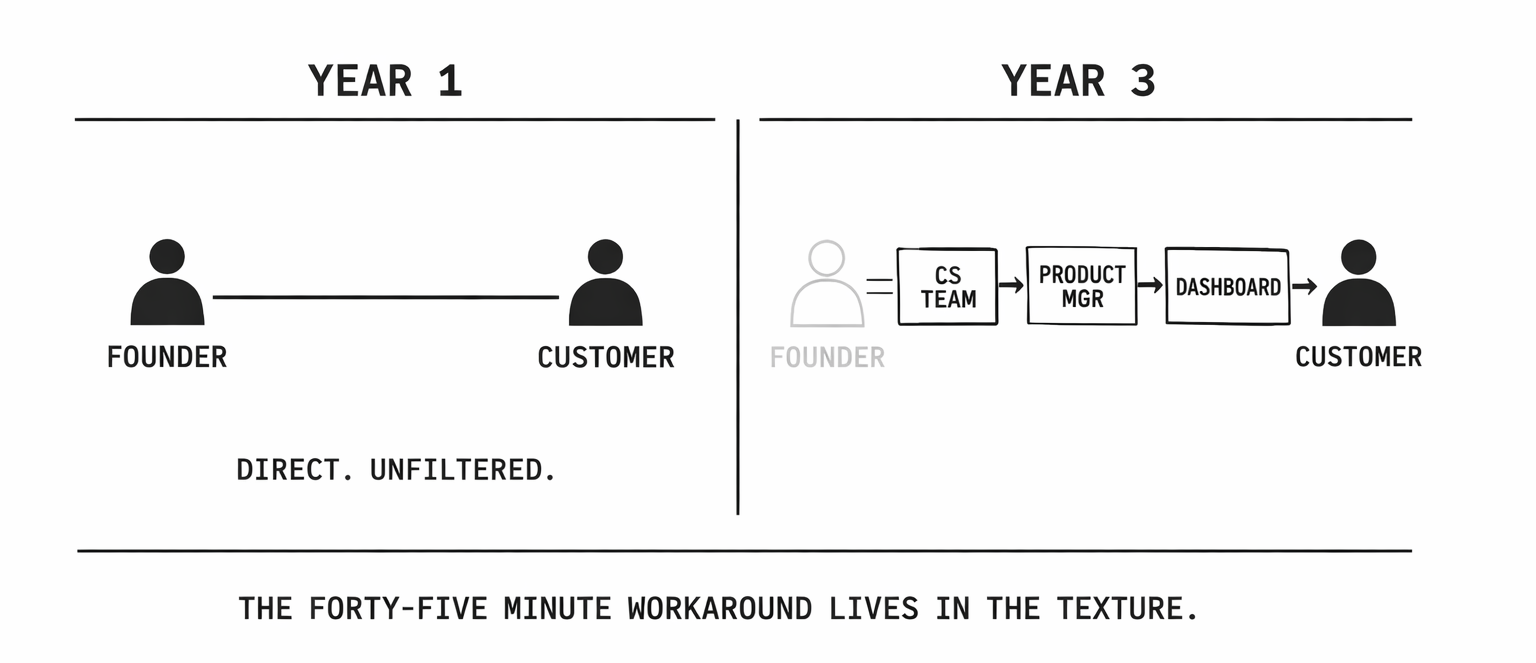
There is a specific moment in most startups when things start to go wrong and nobody notices. The company has raised money. The team has grown. The founder is managing people, investors, and operations. Customer calls still happen, but customer success handles them now. Product feedback still arrives, but a product manager synthesises it into a dashboard before it reaches anyone who builds.
The founder is still technically connected to the customer. They are just no longer in the room.
What gets lost in that translation is not the facts. The facts make it through. What gets lost is the texture: the workaround the customer invented and does not even think of as a workaround. The thing they mentioned almost in passing. The frustration they never named because they assumed it was their own fault. The forty-five minutes every Monday morning that the founder would only have discovered by being there.
That texture is where the real product decisions live. Once it stops reaching the people building the product, the company starts solving problems it invented instead of problems its customers actually have.
Empathy Is Not Warmth. It Is a Practice.
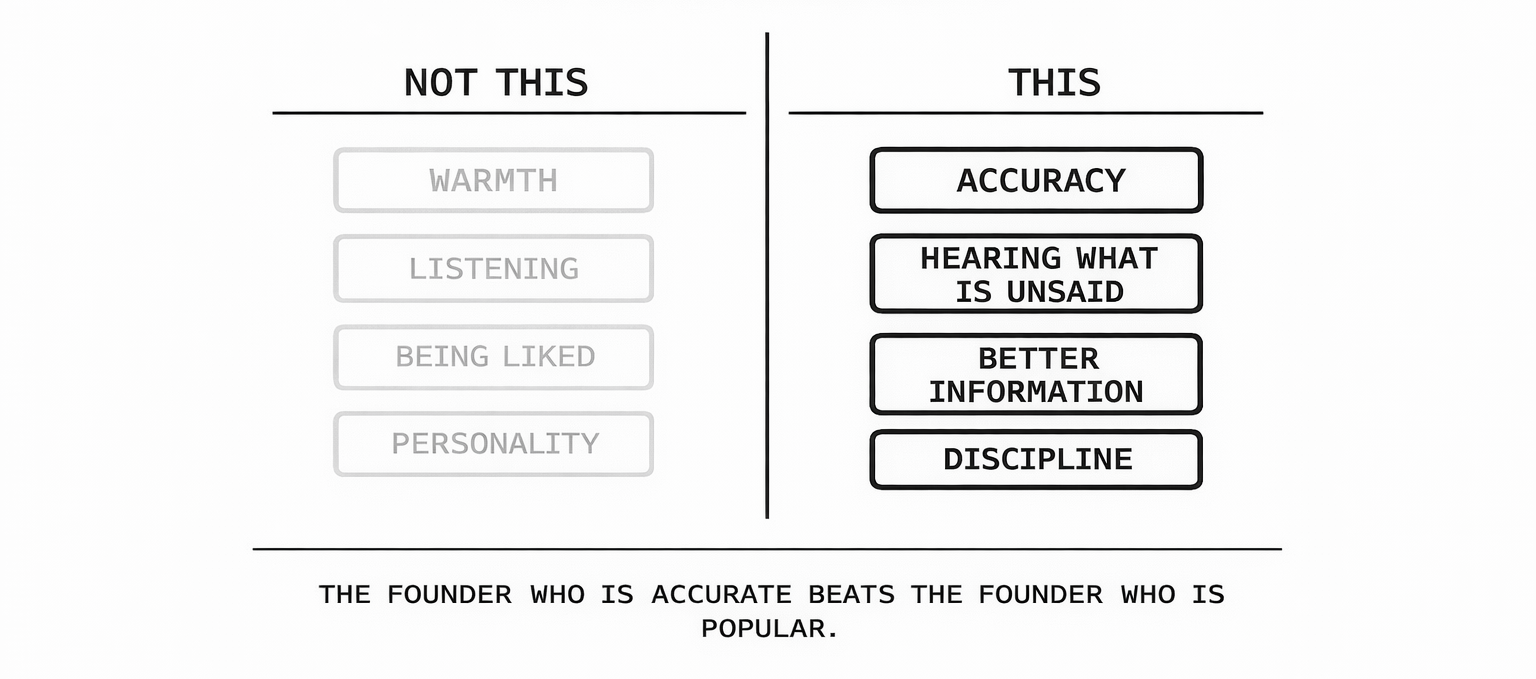
The word empathy makes some founders uncomfortable. It sounds like something from a management training seminar, the opposite of being analytical, data-driven, rigorous.
It is none of those things.
Empathy in a startup is a discipline. A set of deliberate practices that close the distance between the person building and the person paying. It is not about being warm or likeable. It is about being accurate.
The founder who understands their customer's reality well enough to anticipate problems the customer has not yet named is not being soft. They are operating with better information than any competitor relying on support tickets and NPS scores. In a market where AI compresses feature development to near zero, the quality of your information about what to build is the only thing separating good allocation from waste.
The founders who build durable companies develop a specific skill over time: they learn to hear what is not being said. They sit with an answer that does not fit their current model and let it reshape their thinking rather than filing it away.
What African Founders Get Right and What They Risk Losing
Founders building in Lagos, Nairobi, Accra, and Johannesburg have a structural advantage that most Silicon Valley companies spend millions trying to manufacture: proximity to their customer. They live in the same cities. They use the same infrastructure. They understand intuitively what global SaaS companies get consistently wrong about how money moves, how decisions get made, how trust is built in these markets.
That proximity is an advantage only if it is maintained.
The company that hires a business analyst to sit between the engineering team and the customer has not made a bad hire. It has made a structural choice that reduces the variance of outcomes, which means it also reduces the ceiling. The businesses run by founders who still take customer calls in Year 3, who know their ten best customers by name and business context, who read support tickets instead of summaries, those are the businesses that keep finding the insight their competitors miss.
Global SaaS players have spent years trying to understand African markets through research reports and localisation consultants. A founder in Accra who speaks directly to customers every week does not need a report. They already know. The question is whether they protect that advantage as the company scales, or quietly trade it away for operational convenience.
The Compounding Nature of Customer Knowledge
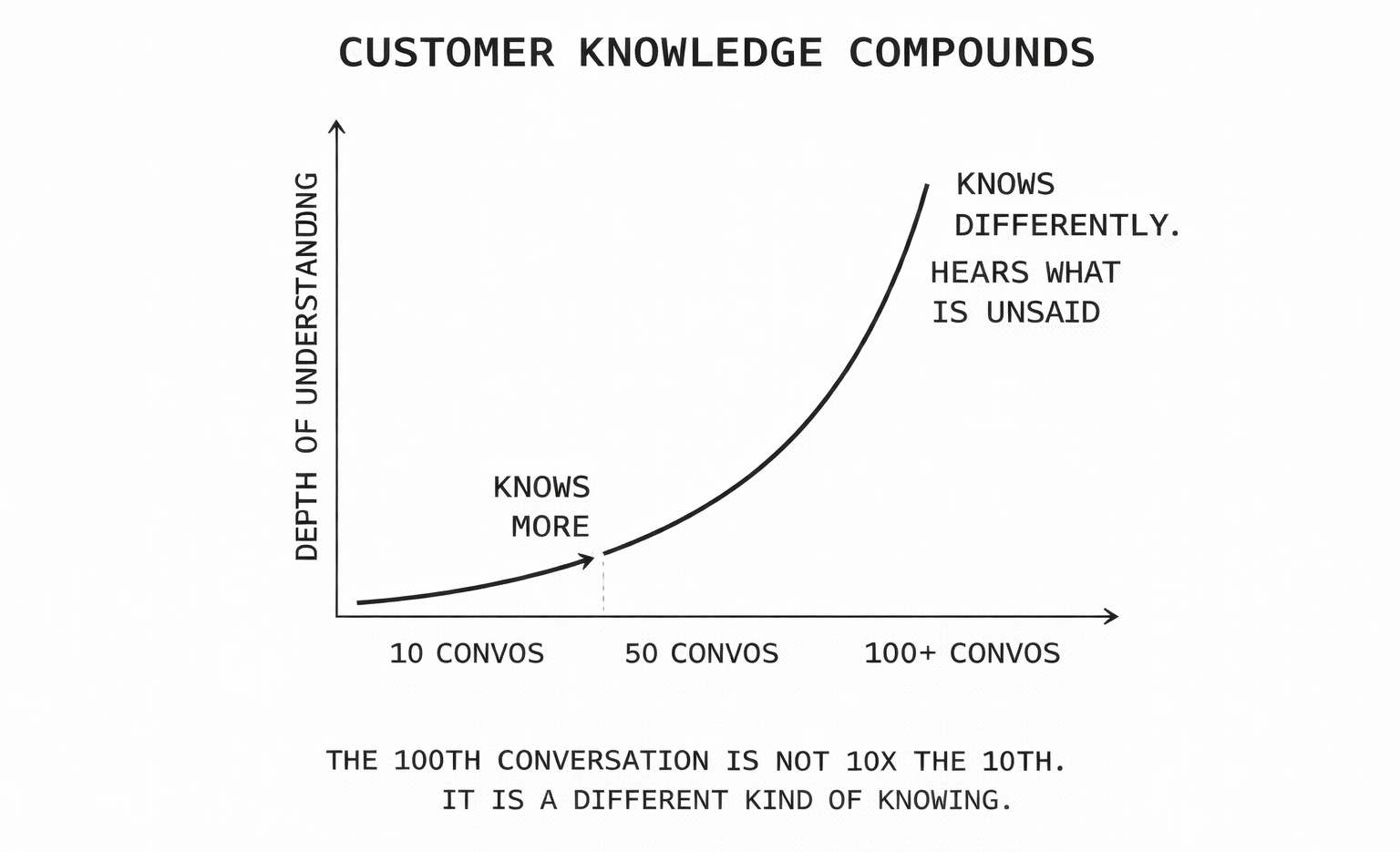
Y Combinator has repeated the same instruction to every cohort for twenty years: talk to your users. Not because it is a nice habit. Because it is the one practice whose returns compound in ways that no other investment can replicate.
Every customer conversation makes the next one more useful. The founder who has spoken directly to a hundred customers does not just know more than the one who has spoken to ten. They know differently. They have sat with enough unexpected answers that their assumptions have been rebuilt from the ground up. They can walk into a product meeting and say: this feature solves a problem our customers stopped having six months ago. And they can prove it.
That capability cannot be delegated. It cannot be purchased. Once built, it is extraordinarily difficult for a competitor to replicate, because it lives not in the product but in the founder.
Your competitor can copy your features. They can reverse-engineer your pricing, clone your interface, and hire away your engineers. What they cannot do is copy the depth of understanding you have built about your customer's reality, if you have actually built it.
What Doing This Well Looks Like
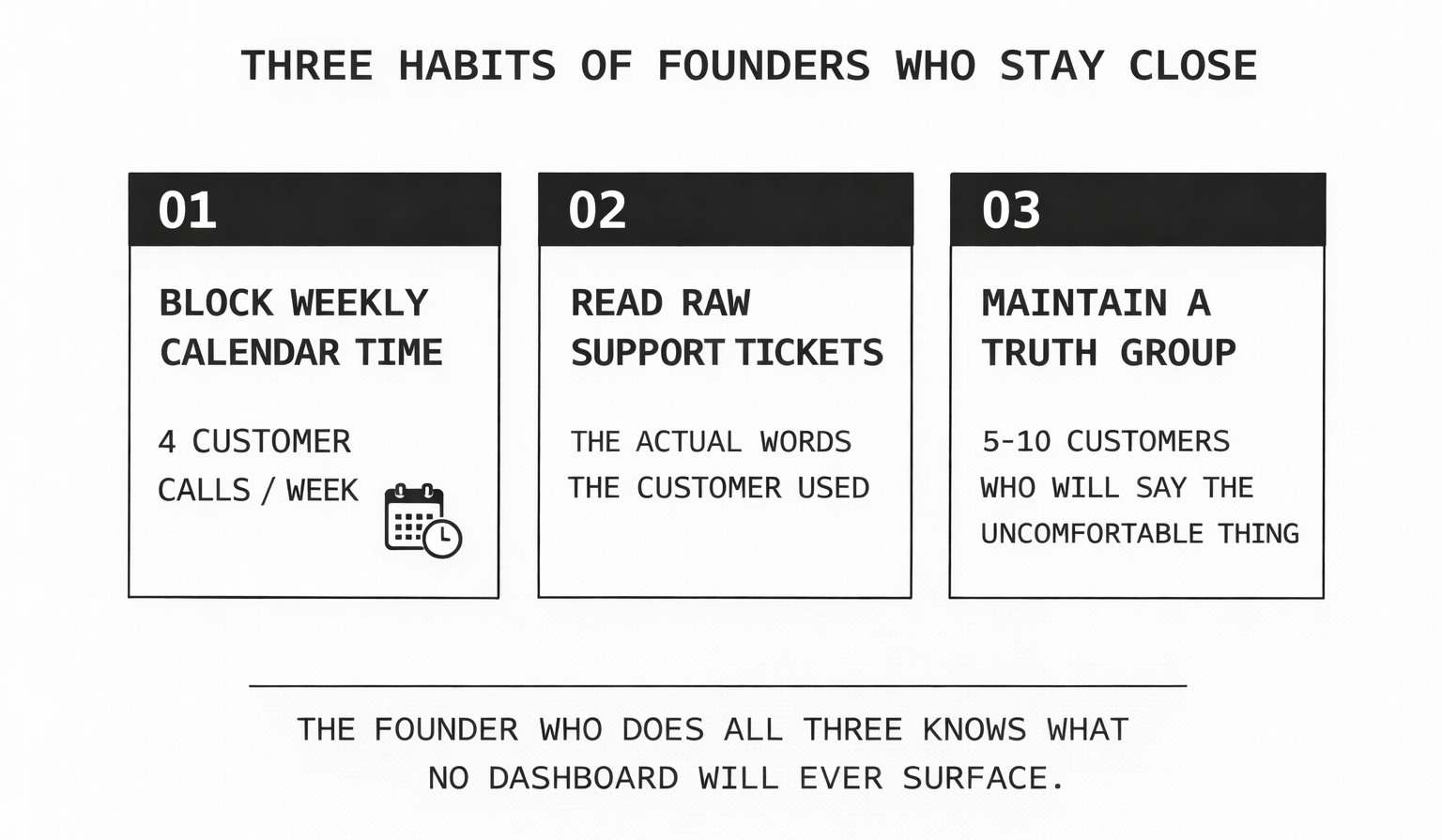
The founders who maintain genuine customer empathy at scale share three visible habits...