The Word Before the Code

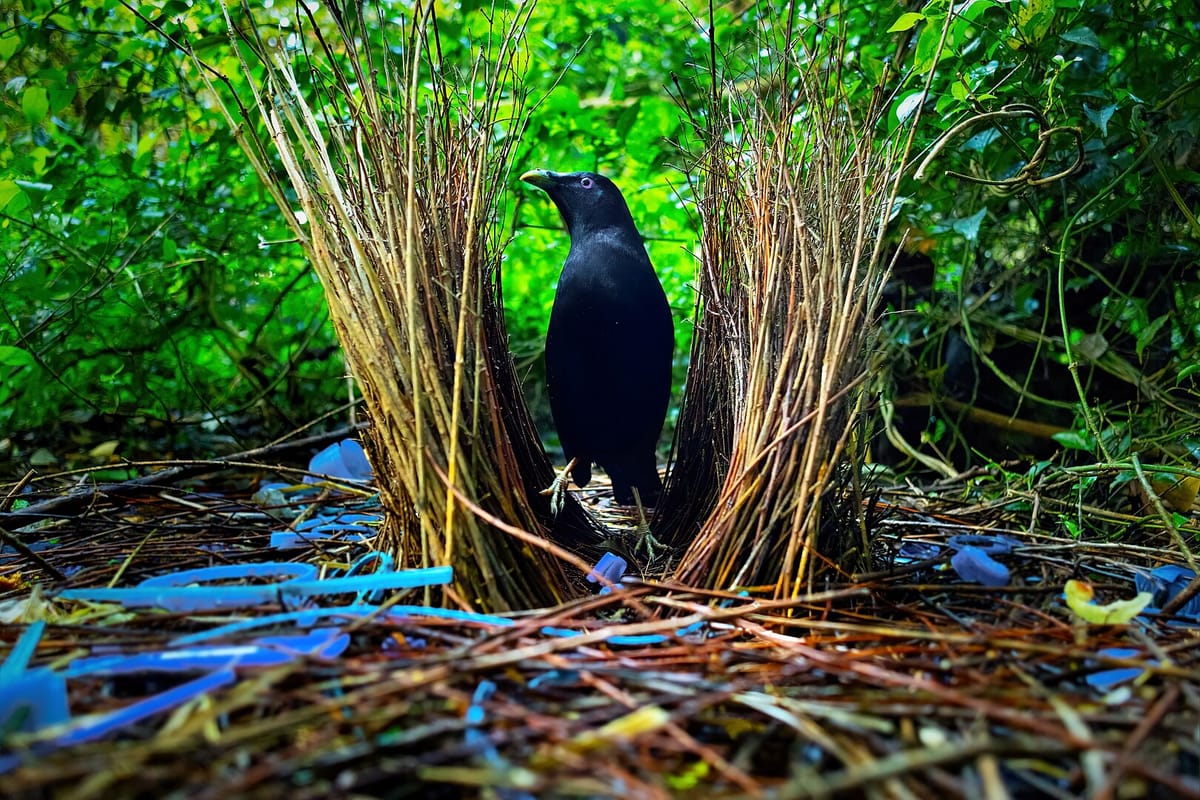
Recently, I've been closely observing creation, driven by genuine curiosity and filled with countless questions. It began by simply noticing the fascinating instincts of animals:
A bowerbird thoughtfully arranging vibrant colors to attract a mate.
A poison dart frog delicately carrying tadpoles on its back through dense forests.
Orcas cleverly collaborating to dislodge seals from ice floes.
These creatures do more than survive. They perform, plan, sacrifice, collaborate, deceive, and sometimes give everything. Their lives unfold like poetry, patterned, purposeful, and choreographed.
And so I began to wonder: "Who or what directs this intricate dance?"
Chance or design?
The frog doesn't understand the physics of its leap, yet its body obeys flawlessly.
The elephant can't chart a map, yet its memory preserves generations of sacred routes. Bees, whales, ants, and wolves—all acting in ways they don't fully comprehend, yet fulfilling roles critical to their survival.
This logic permeates nature: seasons changing, animal migrations, planetary movements, even molecular bonds and DNA. Patterns layered within patterns, interconnected in ways both obvious and deeply mysterious.
The wonder and complexity of biological life is difficult to understate. Humans are so used to the miracle of life which flourishes and fluctuates all around them, that it is easy to forget that biology is, at core, not magic, but matter. It is a combination of chemical elements like carbon, which may be found elsewhere in the universe in distinctly non-living forms.
Life, like truth and time, is very easy to recognise, but difficult to define. What makes living matter different than non-living matter? As difficult as it is to say, one feature which definitely sets life apart is its ability to self-replicate. While most multicellular organisms reproduce sexually, the very cells that exist within them are perpetually dying, reproducing, and expanding. This is a property found in no other chemical combination in the known universe, and it is made possible thanks to two tiny molecular machines engaged in an elaborate and ongoing dance: DNA and RNA.
While the geological processes within planets and the thermonuclear processes in stars are fascinating and complex, neither is so dynamic as the way in which life grows, learns, responds to its environment, evolves, and behaves. It is this very dynamism which has led people throughout history to marvel at life and conclude that there must be a mind behind it all. But is this merely a superstitious instinct passed down through the ages, or is there some reality to this belief?
Looking back across the ages, sceptics have noted that people always seem to ascribe to the supernatural what has proven to be quite natural. In ancient times, people left thunder and volcanoes, the rising of the sun, and the seasons themselves in the domain of the gods. These, we gradually learned, had ordinary physical explanations. Isaac Newton, for all his brilliance, did leave room for God to shepherd the planets in their unusual movements, which later proved to be quite natural when the baton was passed to the ingenious Mister Einstein.
Because of this long history of the complexity of the universe being shown to have entirely natural causes, when something like the mystery of the universe’s origin or the enigma of DNA are laid upon the table as proof for God, sceptics do what sceptics do, and remain very sceptical. The term “god of the gaps” was coined to describe the way in which humans seem to always use God as an explanation for things unknown – an explanation which proves unnecessary as science progresses.
However, it is not what we don’t know about DNA which causes us to grasp toward God, but rather what we do know. We have mapped the human genome in its entirety, are quite aware of its exact structure and function, and the sequences in other life forms across the planet are not far behind. In other words, there are fewer “gaps” into which a God may be shoved.
I argue that it is this very comprehensive knowledge of the inner workings of the genetic world which make God seem like a possibility – even a probability. But how so?
DNA: The Language of Life
Life, from the most complex creature to the simplest bacterium, cannot exist without DNA.
No matter how insignificant a life form is, it contains some kind of DNA or RNA. DNA consists of two long molecules winding around one another, and joining together by nitrogenous “base pairs” like rungs along a ladder.
There are four different nucleotides which may be combined to make base pairs. It is through these four nucleotides that all of the information within a DNA strand is encoded. The English alphabet has 26 letters which may be combined in any particular order to make any of over 170,000 words. Those words form sentences, which form paragraphs, which form books, which communicate the sum total of human knowledge. Genetic code contains only four letters. The four letters contained in the DNA code - A, C, T, and G – can be combined in any order to make up the over 7 - 8.5 million species living on this planet – each individual of which has a unique set of DNA. The DNA contains the blueprint for the form of the entire organism it helps to produce.
When the Human Genome Project mapped out the details of human genetics, what it discovered was language – information – which could literally be read and interpreted in order to discover the design of the human body.
In order to grasp the significance of finding language encoded in DNA, it is important to have some idea of the significance of language.
Take a word like “love.” This simple, four-letter word has taken an expansive idea which is part of the human experience, encoded it in a simple form, and transmitted it to the reader. If a man says “I love you” to his child, he has used three words to communicate a massive truth which has significant effects on his child’s world.
This is the nature of language, it encodes large ideas in simple terms, transmits those ideas, at which point the idea emerges on the other side.
This is the nature of DNA. Within this tiny molecule is contained the blueprint for an entire body. As scientists seriously consider taking ancient DNA discovered in the frozen bodies of mammoths, and from these tiny strands bringing the extinct creature back to life, they demonstrate the capacity for DNA to transmit information.
Given that DNA is unmistakably a form of language, it implies a mind behind the language.
“Intelligent design” argues in much the same way as I have above, that the specified and irreducible complexity of life as we know it is best explained by an intelligent designer, and not by natural processes.
Ancient Questions, Ancient Answers
Humans uniquely question this. Only humans ask: "Who created this? Why are we here?" Why are we uniquely aware and curious about this deeper reality?
These are questions that have bothered human civilisation through the ages, and these are difficult questions, if not some of the most hardest questions. The entire religious, philosophical, and scientific enterprise of the human race for the past multiple millennia has been pursuing our upward aim for truth.
When solving problems: the older the problem, the older the solution.
If you’re trying to learn how to drive a car or fly a plane, you should read something written in the modern age because this problem was created in the modern age and the solution is great in the modern age.
If you’re talking about an old problem like how to keep your body healthy, how to stay calm and peaceful, what kinds of value systems are good, how you raise a family, and those kinds of things, the older solutions are probably better.
Any book that survived for two thousand years has been filtered through many people. The general principles are more likely to be correct.
A man is coming after me who is far greater than I am, for he existed long before me. (John 1:30)